
Microsoft Azure Compute is represented by a wide array of service offerings. This diversity can be overwhelming, especially for new users unfamiliar with Microsoft’s ecosystem. Following Mind Map (you may use it as Decision Tree) represents Microsoft Azure Compute Services grouped into five categories:
- Virtual Machines (IaaS). Traditional infrastructure hosting where it is possible manage the operating system and runtime environment on virtualized hardware. Great for “lift-and-shift” migrations, custom OS requirements, or workloads that demand fine-grained control over configuration and security.
- Containers & Orchestration. Services for packaging applications into portable containers and managing them at scale (e.g., with Kubernetes or Service Fabric). Ideal for microservices and distributed architectures that benefit from automated deployment, scaling, and resource isolation.
- Serverless & Integration. Event-driven and fully managed services (like Functions, Logic Apps, Service Bus) that eliminate server management, enabling quick, on-demand code execution and enterprise messaging. Perfect for rapid development of small tasks or workflows, integration across services, and asynchronous processing with minimal overhead.
- App Hosting (PaaS). Fully managed platforms (Web Apps, API Apps, Mobile Apps, Spring Apps) that handle much of the underlying infrastructure so you can focus on code. Streamlines deployment, scaling, and maintenance, allowing teams to deliver web, mobile, and API solutions quickly without worrying about server administration.
- HPC & Specialized Compute. High-performance computing solutions (Azure Batch, CycleCloud) and specialized offerings like GPU-optimized VMs, Quantum, or SAP HANA Large Instances. Supports large-scale simulations, AI/ML training, and enterprise mission-critical workloads that require massive compute, memory, or specialized hardware.
Roles on the right side of the Decision Tree provide oversimplified generalization of who usually works with these services. Because of this simplification order of listed services is random.
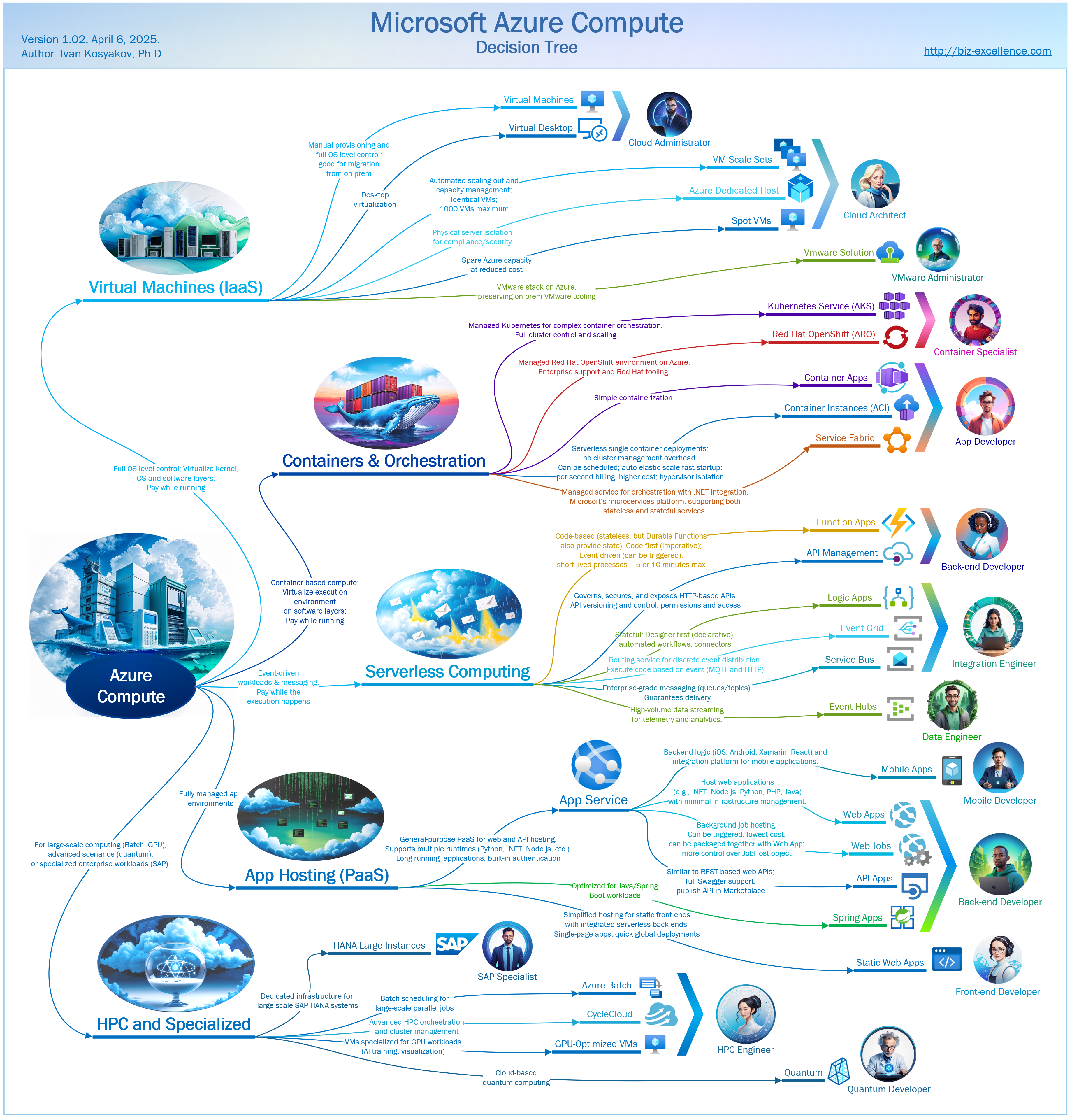
List of Azure Compute Services
Here is the list of services mentioned in the decision tree.
Virtual Machines (IaaS)
- Azure Virtual Machines provide granular OS-level control ideal for lift-and-shift migrations or custom configurations.
- Azure Virtual Desktop uniquely combines PaaS-managed control planes with user-managed IaaS session hosts, balancing ease of management and customization.
- Virtual Machine Scale Sets streamline the automated scaling of identical VM instances.
- Azure Dedicated Host offers physical server isolation essential for strict compliance and security needs.
- Azure Spot Virtual Machines leverage spare Azure capacity at lower costs but with potential preemptions.
- Azure VMware Solution integrates native VMware stacks within Azure for organizations maintaining VMware ecosystems.
Containers & Orchestration
- Azure Kubernetes Service (AKS) simplifies complex container orchestration, providing robust cluster management and scaling capabilities.
- Azure Red Hat OpenShift (ARO) delivers managed OpenShift solutions with enterprise-grade features.
- Azure Container Apps support serverless microservices with automatic scaling through KEDA, sitting between AKS and ACI in terms of complexity.
- Azure Container Instances (ACI) facilitate lightweight, serverless single-container deployments ideal for quick and simple tasks.
- Azure Service Fabric enables advanced microservices architectures supporting both stateless and stateful services.
Serverless & Integration
- Azure Functions offer event-driven, serverless compute capabilities with code-centric flexibility, ideal for rapid development and scalability.
- Azure API Management provides robust governance, security, and management capabilities specifically designed for REST-based APIs.
- Azure Logic Apps complement this with visual, low-code integration and workflow automation, simplifying complex business processes.
- Azure Event Grid serves as a centralized event routing platform, efficiently distributing events across various services.
- Azure Service Bus ensures enterprise-grade messaging reliability with guaranteed delivery.
- Azure Event Hubs specialize in handling high-volume streaming data scenarios.
App Hosting (PaaS)
- Azure App Service Mobile Apps empower backend logic and integration services tailored explicitly for mobile applications across iOS, Android, Xamarin, and React platforms.
- Azure App Service Web Applications offer robust managed hosting environments optimized for various web runtimes and rapid deployment scenarios.
- Azure App Service Web Jobs support efficient background job execution, integrated seamlessly with web applications.
- Azure App Service API Apps provide specialized hosting for RESTful APIs, complete with full Swagger support for easy discovery and integration.
- Azure Spring Apps cater specifically to Java developers, providing managed infrastructure tailored for Spring Boot applications.
- Azure Static Web Apps efficiently host static front-end applications integrated seamlessly with serverless backend capabilities.
HPC & Specialized Compute
- SAP on Azure provides specialized infrastructure uniquely optimized for SAP HANA workloads, supporting high-performance, enterprise-grade SAP deployments.
- Azure Batch facilitates straightforward scheduling and execution of batch jobs, ideal for large-scale parallel computations without complex cluster management overhead.
- Azure CycleCloud enhances this capability by offering sophisticated orchestration and management of High-Performance Computing (HPC) clusters.
- GPU-Optimized Virtual Machines specifically target compute-intensive GPU workloads like AI and machine learning.
- Azure Quantum introduces quantum computing capabilities, opening new computational possibilities.
Interesting Insights
Here are some additional observations which someone might find helpful.
- Containers vs. Virtual Machines. Azure Kubernetes Service (AKS) and Container Instances (ACI) provide lighter-weight, scalable alternatives to traditional virtual machines, significantly streamlining application deployment and management, particularly beneficial in microservices architectures.
- Serverless Computing Ecosystem. Azure’s serverless compute offerings, such as Functions and Logic Apps, eliminate infrastructure management entirely, promoting rapid development and scalability for event-driven and workflow-driven applications.
- Integration and Messaging Diversity. Azure’s integration services (Service Bus, Event Hubs, API Management) each address distinct messaging and data streaming scenarios, from reliable transactional messaging to high-throughput analytics ingestion, enhancing architectural flexibility.
- Comprehensive App Hosting Options. Azure provides comprehensive app hosting solutions tailored for various types of applications—from web and mobile apps through App Services to specialized Java workloads through Azure Spring Apps—allowing developers to select the most effective platform for their specific needs.
- Clear Separation of Azure App Service Types. Azure App Service distinctly categorizes workloads into Web Apps, Web Jobs, API Apps, and Mobile Apps, each optimized for specific scenarios—front-end web hosting, background job execution, REST API management, and mobile application backends respectively.
- Specialized HPC and GPU Compute Resources. Azure’s specialized compute options, including GPU-optimized VMs, CycleCloud, and Azure Quantum, cater specifically to high-performance computing and intensive workloads like AI training and quantum simulations.
Is anything very important missing here? Do you want to see deep dive into any groups of these (or other) services?
Please let me know…
See also: Computation Workloads (Compute in Azure)

 Business Excellence